Financial Market Fundamentals
A structured crash course in Indian financial markets: equity, debt, forex, commodities and crypto, with mechanics, costs, regulation, investing and trading realities, and taxation.
Most people meet the stock market by accident: a tip from a friend, an app screen, a headline about a crash. This course fixes that. It is a structured introduction to Indian financial markets: what the markets are, who trades in them, how the plumbing works, what it costs, how you are protected, and what the evidence says about making money in them.
Twenty-two lessons, each short enough to read in one sitting. Read them in order the first time; later they work as reference.
- 01What financial markets areThe four regulated markets in India (equity, debt, forex and commodities), plus crypto, and what each one is actually trading.
- 02Market participantsThe three intentions behind every order (investing, trading and hedging), who carries each one, and the machinery that settles what they trade.
- 03Stock exchangesBSE, NSE, MCX and NCDEX: the hours each one trades, what an exchange is, how price discovery works, and how the equity day actually runs, from the opening auction to settlement.
- 04The Share MarketWhat a share is, primary and secondary markets, face, book and market value, market capitalisation, and how dividends, bonus issues, splits and rights issues work.
- 05Fundamental AnalysisHow to read a company's financial statements, the ratios that matter, how valuation works in outline, and the red flags that appear before a loss.
- 06Technical AnalysisHow to read a price chart: candles, trend, support and resistance, volume, moving averages and indicators, and what technical analysis honestly cannot do.
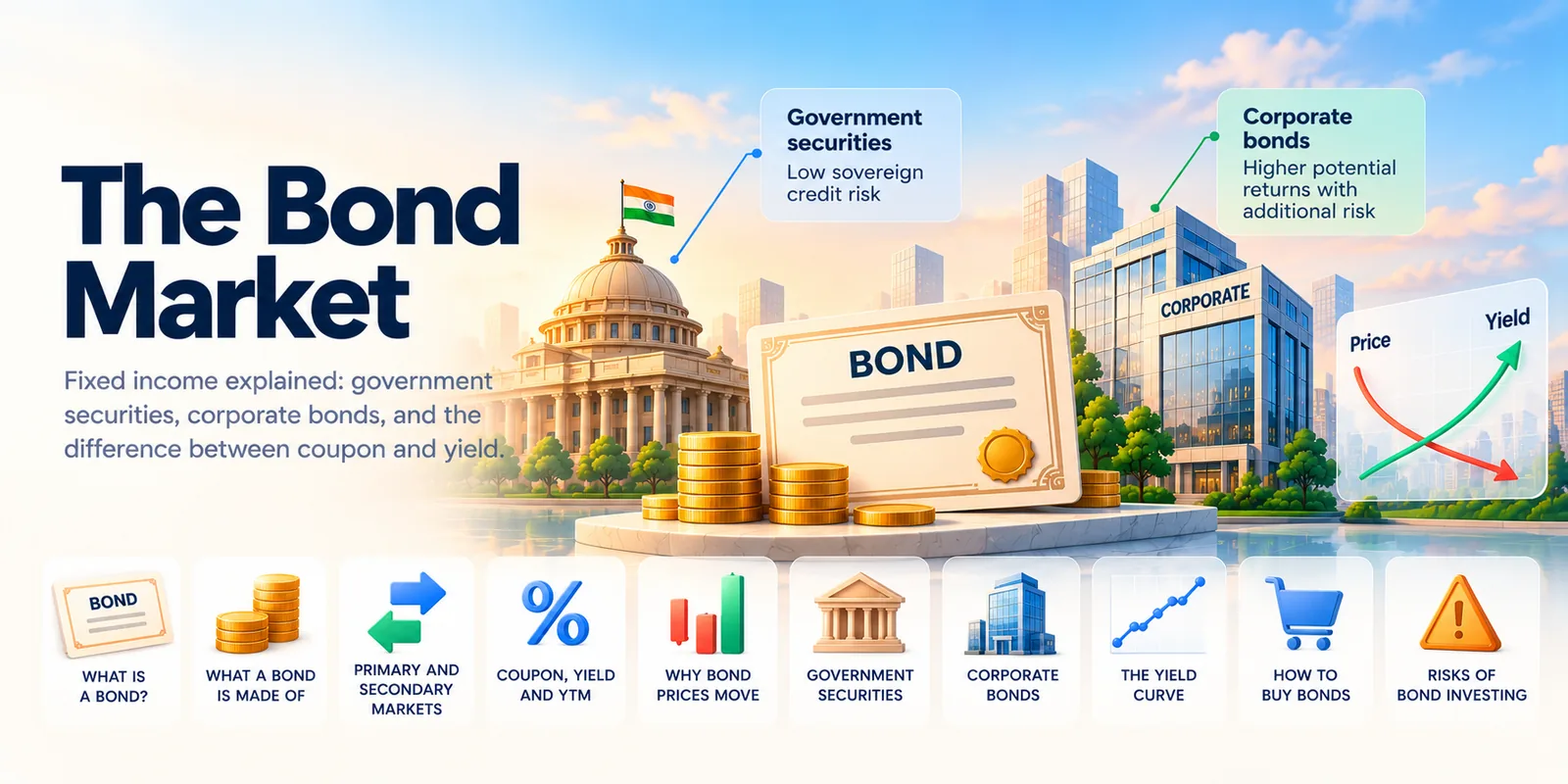
- 07The bond marketBonds explained: government securities, corporate bonds, how price and yield move in opposite directions, what duration measures, and how to buy them in India.
- 08The forex marketCurrency pairs, spot, forwards, futures and options, the permitted channels under FEMA and RBI rules, and how to spot an unauthorised forex platform.
- 09The commodities marketCommodity futures and options, trading hours by category, contract sizes, margins, physical delivery, and the risks of option devolvement in India.
- 10The crypto marketLearn crypto trading in India: Bitcoin, Ethereum, spot, futures, options, exchanges, taxation, FIU rules and investor risks.
- 11DerivativesUnderstand what derivatives are, why they exist, how futures and options differ, and the risks of leverage.
- 12FuturesUnderstand long and short futures, contract sizes, profits and losses, daily settlement, rollover and expiry in India.
- 13OptionsOptions explained: calls, puts, moneyness, premium, time decay, implied volatility, Black-Scholes, the Greeks, exercise, settlement and the risks of buying and writing.
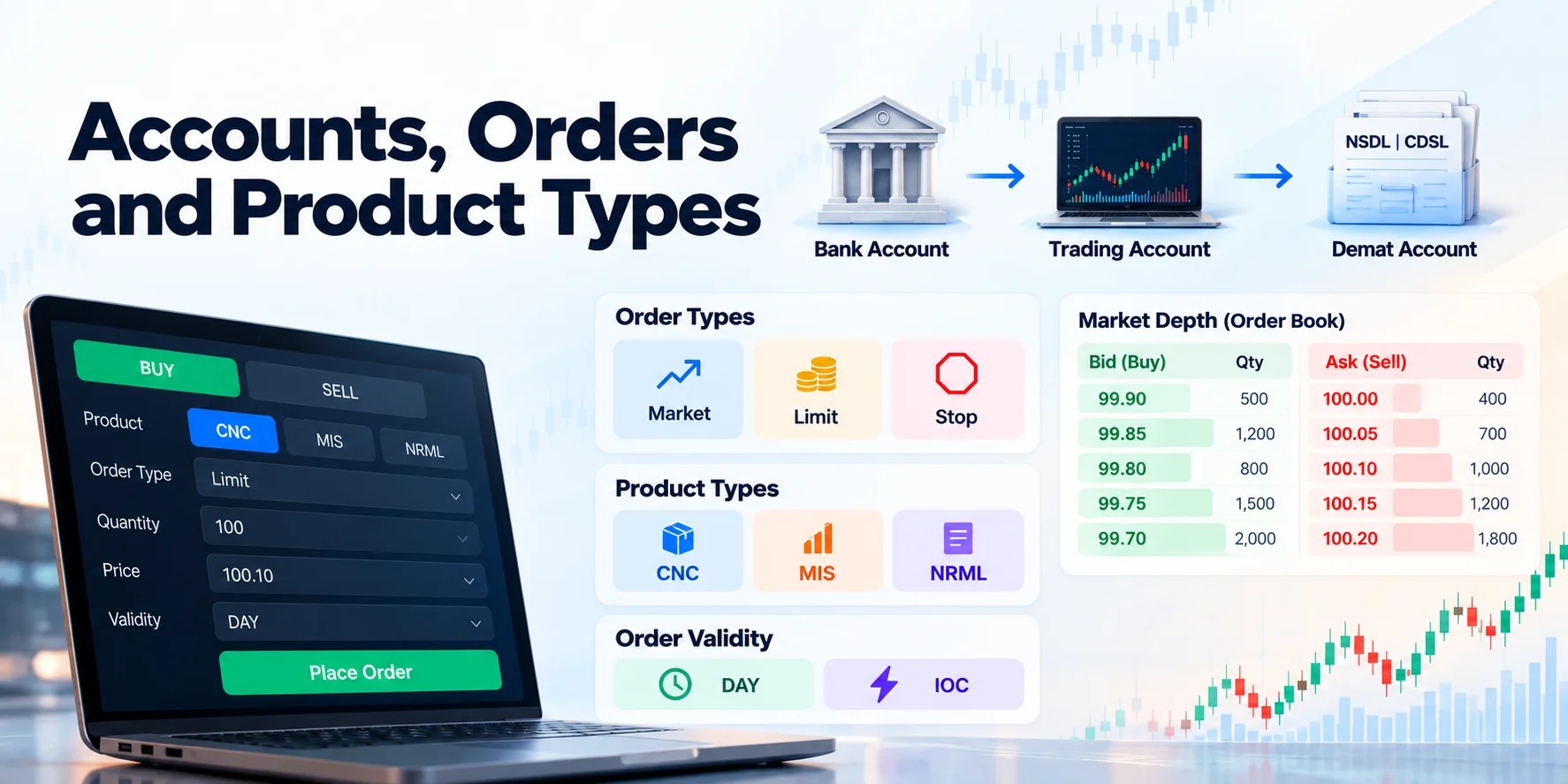
- 14Accounts, Orders and Product TypesUnderstand trading and demat accounts, CNC, MIS, NRML, market and limit orders, stop-losses, order validity and market depth.
- 15What It CostsUnderstand brokerage, STT, CTT, GST, exchange charges, stamp duty, demat fees and the real cost of every trade.
- 16SEBI and investor protectionWhat SEBI regulates and what it does not, how to verify a broker or adviser, the Investor Protection Fund, and the grievance clock with deadlines.
- 17The reality of investingWhat historical returns really tell us, how risk affects compounding, whether IPOs are worth considering, and how mutual funds fit into long-term investing.
- 18The reality of tradingWhat SEBI's research reveals about retail trading losses, why transaction costs matter, and what a mechanical trading system can and cannot control.
- 19TaxationHow Indian tax treats investing and trading: the two Acts, how income combines across heads, capital-gains rates, set-off, audit and filing.
- 20Mutual Funds, ETFs and SIPsHow pooled funds work, the difference between active funds, index funds and ETFs, what a SIP does and does not do, and the costs that decide the outcome.
- 21Risk Management and Position SizingHow much to risk on a trade, how to size a position from the entry and the stop, why drawdowns are harder to recover than they look, and how leverage changes the maths.
- 22Algorithmic Trading ApproachesThe main families of automated strategy, what each one needs to work, how execution and costs decide the result, and why a backtest is not a promise.
How to use this course
The facts here are current as of writing, but market rules, charges and tax rates change. Where a number matters, check it against the exchange circular or the Income Tax Department before you act on it.
Every lesson has a video slot at the top. The written version is complete on its own; the videos are there when you would rather watch.
Once you have read the taxation lesson, the income tax calculator will tell you what you owe for FY 2026-27 under both regimes, and how much advance tax is left and when to pay it.
If something is unclear, ask us or join the Discord community.