It's a Business, Treat It Like One
Treat trading like the business it is. What is realistic to expect, and the features that make trading unlike most other businesses.
Having a sane mind while trading depends a lot on having realistic expectations. Trading the market is like running a business. When we open a trading account we are actually starting a business. A business needs a solid plan and capital to start and to keep running. It needs time to grow, can book losses and can have profits. It needs appropriate knowledge and skill, and it should have accounting and auditing, compliance requirements and risk-management practices. Each one of these aspects applies equally well to trading.
But every business has its own character: its own innate flavour, with its own pros and cons. Trading is no different, and it comes with the following unique features.
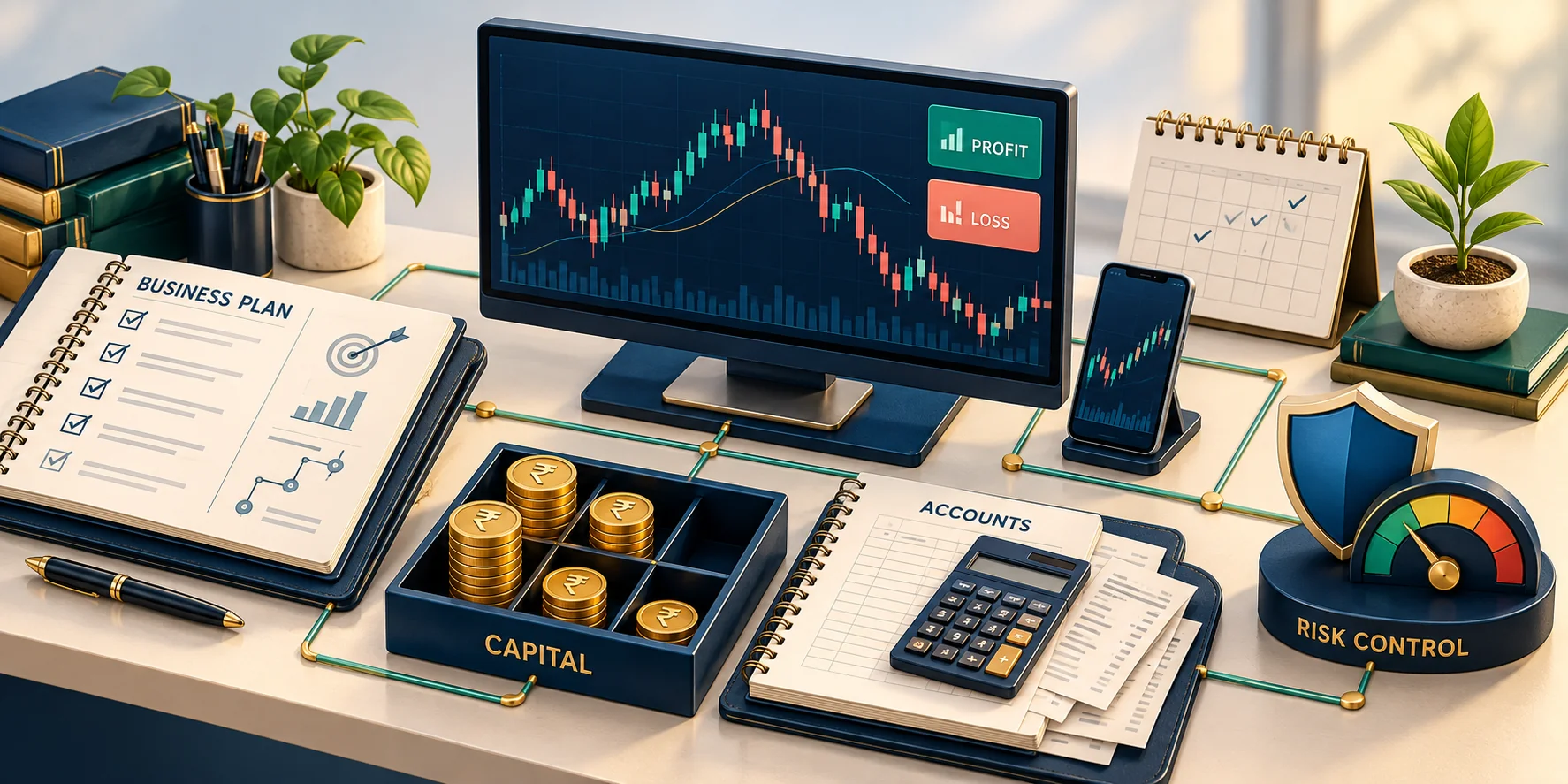
What is unique about trading as a business
- Easy to start. Today it takes around ten minutes to get onboarded with a stock broker, and the account is activated within a day or two. Some brokers do not charge anything for the process. Transfer capital into the account and you are ready to trade, and to start earning, or losing. You can trade from home, from the office, or on the move, so there are no spatial constraints if you have a connection. You also need no government licence, no compliance requirement and no minimum education, unless you are a government servant.
- Low capital investment and running expenses. Depending on your trading style, all you need to start is a mobile phone or a PC, which will be your capital investment. You will need an active internet connection, pay small charges while placing a trade, and perhaps account and audit your books. Those are the running expenses. Both are modest compared with other businesses.
- Instant pain and gain. Once a trade is entered and exited, the net profit or loss is booked instantly in the trading account.
- Instant credit. It is possible to quickly avail credit analogous to secured debt (pledging holdings) or unsecured debt (margin funding), even for the credit-unworthy, through the broker. There is no strict vetting process as there is for other businesses.
- Extreme liquidity. Your trade equity is liquid cash in digital form, and profits and losses are adjusted against it electronically. Cash can move between your trading account and bank account quickly, except for the minor broker processing delay on withdrawals.
- Low macro-economic impact. In trading it is possible to profit whether the market goes up, goes down, or stays flat or volatile. Unless a catastrophic event such as a natural disaster or a war halts the exchanges, the process is insulated from macro-economic events.
Do not dive into trading if you cannot make peace with the reality pictured above. You are likely to fail, as 90% of startups do in their first year and as the SEBI study on individual traders shows. If you are at ease with that scenario but unsure how to proceed, we present TrendShikari NTS for your consideration.